
2025 in urban health
Looking back at Impact on Urban Health's highlights in 2025.
Read more
Urban health
Wood & Water partnered with Impact on Urban Health to explore how to make conversations around climate change, health inequalities and racism more inclusive. In this guest blog, Natalie Lartey from Wood & Water shares what we’ve learnt.

In urban areas, one of the most significant long-term challenges to health equity is climate change. For example, people living in poor-quality housing, managing long-term health conditions, or surviving on low incomes are far more vulnerable to extreme temperatures.
Yet the communities most affected often contribute the least to climate change and are frequently excluded from climate activism and developing strategies to address climate change.
Over the past year, we worked with Impact on Urban Health to run Climate Calling, a youth-led project exploring the connections between climate change, public health, and racial justice in Lambeth and Southwark. The initiative reached over 1,350 young people and community members through exhibitions, school assemblies, and digital activities.
But the real lesson for funders is this: the stories we choose to highlight – and the ones we leave out – directly shape what gets funded, who gets heard, and what change becomes possible.
Through this project, we asked a tough question: What missing narratives might be holding back progress on climate change and health equity?
Two key themes stood out:
1. Climate discussions often overlook structural racism and colonial history
Policymakers, academics and the media mostly focus on the science of climate change but often ignore the systems that create economic inequality and racial inequities. When these factors are left out, it limits the solutions we imagine, the projects that get funded and the communities that receive support.
2. Young people and community groups are undervalued as knowledge creators
Young people from Black and ethnically minoritised backgrounds, along with community groups and grassroots organisations, are often undervalued and their contributions overlooked. Climate Calling showed that when people are meaningfully engaged, they surface insights that traditional forms of research cannot.
The solution to these gaps is simple but powerful: communicating about climate change in a way that makes clear links with racial and health justice.
Climate Calling showed what happens when these connections are treated as central to mitigating the harmful health effects of climate change.
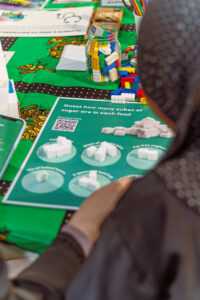
Learning through play, a young person at the Climate Calling exhibit uses a simple activity that shows the hidden stories in our diets. © Wood & Water.
The participants didn’t just learn about climate, race, and health inequalities – they explained them, illustrated them and turned them into public exhibits and digital content. As one young person said, “this was the first time I saw my own story in something about climate.”
For funding organisations working across health, climate, and racial equity, these insights offer clear opportunities.
The climate crisis affects housing, air quality, food, transport and access to green space – issues many funders already prioritise. Mainstream narratives around climate change often focus on individual choices, but being explicit that the crisis will drive poor health helps reveal how existing structures create and reinforce inequalities.
Climate Calling showed four ways that reframing the climate crisis as inseparable from racial and social injustice strengthens our work:
1. It makes space to talk about structural racism
Exploring climate and racial justice together helps show how Black and other ethnically minoritised communities experience these injustices most sharply and opens honest discussion about the history of colonialism and racism and how they act as drivers of climate change.
2. It grounds storytelling in real life
Climate Calling allowed workshop participants and exhibition audiences to connect global challenges to people’s everyday experiences – the air they breathe, the green spaces missing from their neighbourhoods and their experiences of health inequity.
3. It harnesses intergenerational memory
Stories and memories passed down through families help to link historical experiences to today, creating space for conversations about healing and justice.
4. It reaches new audiences
People from Black and other minoritised communities are often labelled as uninterested in climate activism. But when that activism genuinely centres racial justice it can inspire new groups to engage with projects and shape action.
The climate crisis is urgent, but urgency alone does not guarantee meaningful action. For funders it is vital to invite communities to share their stories, to shape decisions and control resource, how just taking knowledge from communities without investing in them risks reinforcing the very injustices we aim to solve.
This means empowering communities to create strategies based on people’s lived experience and generating the types of insights that more formal types of research can’t.
Urban health

Looking back at Impact on Urban Health's highlights in 2025.
Urban health
We’re partnering with NHS South East London to improve the experiences and health of people from Black communities in parts of South London.
Data
How the Urban Health Index can help users better understand the social and environmental factors that shape people’s health and wellbeing.