
Breastfeeding in focus
This report captures the perspectives of those working in and around breastfeeding and creates a policy and practice landscape of breastfeeding at local and national levels.
Read more
Authors: Carole Coulon, Impact on Urban Health; Rosie Osborne, Bremner & Co; on behalf of the Commercial Baby Food Review
August 2026 marks one year since the Government published its voluntary industry guidelines on commercial baby food. These were introduced with a clear intention to address a baby food market flooded with nutritionally inadequate products and misleading marketing claims.
Manufacturers were given 18 months to bring their products into line with the guidelines. With the February 2027 compliance deadline fast approaching, we’re asking: are we seeing meaningful change in the baby food aisle, and is the voluntary approach delivering the healthier market babies and parents deserve?
The Commercial Baby Food Review (CBFR) is a cross-sector initiative working to improve the nutritional composition and marketing of commercial baby and toddler foods in the UK through stronger, enforceable regulation. Funded by Impact on Urban Health, the CBFR brings together First Steps Nutrition Trust, the Obesity Health Alliance, Bremner & Co, Sustain, Planetary Alliance and the University of Leeds, with a particular focus on addressing inequalities in infant and young child feeding.
We are currently conducting a comprehensive evaluation of the baby food marketplace against the full scope of the voluntary guidelines. This includes assessing more than 800 products, capturing parental insight and examining not only nutritional composition, but also marketing and labelling practices. Crucially, we are also assessing whether the guidelines themselves are sufficiently clear and robust to deliver the changes they are intended to achieve.
It is a substantial undertaking. Some elements of the guidelines are open to interpretation, making consistent assessment challenging. But this evidence is essential if we are to understand what is really happening in the market, hold industry to account and ensure parents are not misled when making decisions on what to feed their babies and young children.
Alongside conducting our full evaluation, we are keeping an eye on industry movement. What we are seeing so far is uneven progress.
Some manufacturers and retailers appear to be using the guidelines as intended – reformulating products, reviewing ranges and rethinking how products are labelled and marketed. Others are making changes that may look positive on the surface but do not hold up to scrutiny. We are also seeing new products entering the market that appear to fall short of the guidelines from the outset.
Tesco’s relaunch of its own-brand baby and toddler food range, Fred & Flo, represents a considered attempt to align an entire own-label range with both the composition and marketing elements of the voluntary guidelines. Their new single-ingredient vegetable pouches represent the kind of new product development the voluntary guidelines aimed to initiate.
We welcome this as an example of the kind of retailer-led response the guidelines was intended to prompt. It demonstrates that meaningful change across an entire range is possible when retailers take a proactive approach.
Elsewhere, however, we are seeing approaches that risk misleading parents about the suitability of products.
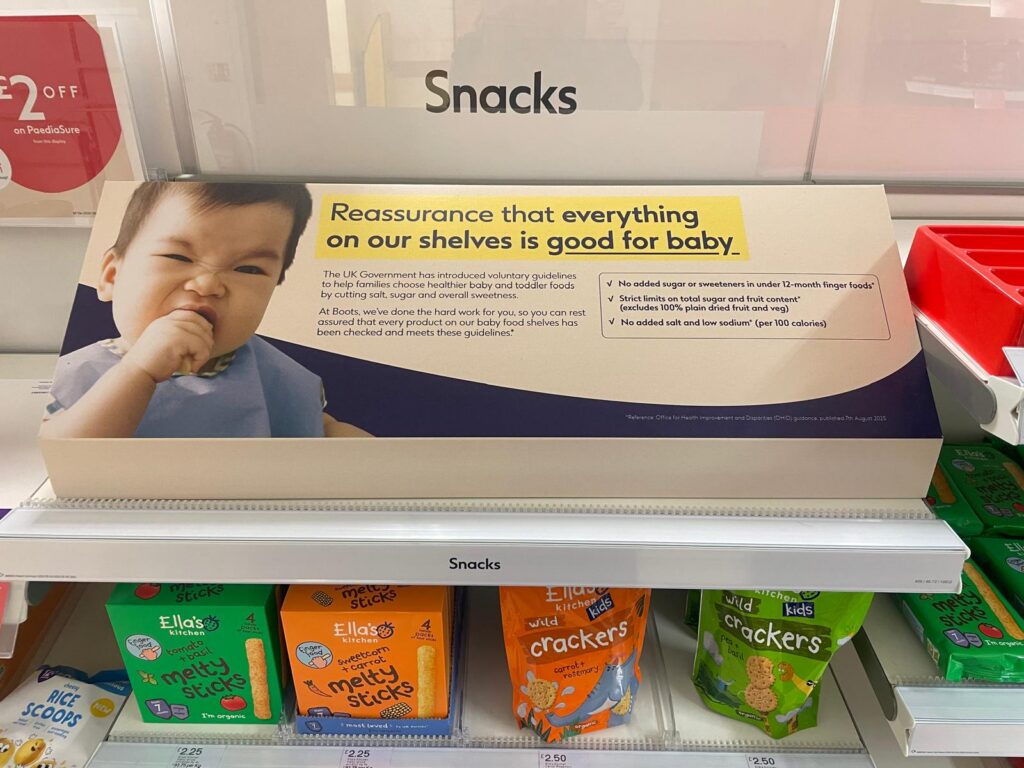
Boots’ “If it’s on our shelves, it’s good for baby” shelf messaging is one example. The messaging sits above a large range of products, including snacks marketed for infants under 12 months, foods labelled as suitable from four months, and products carrying “no added sugar” claims despite containing significant amounts of free sugars. This sits uneasily with both the voluntary guidelines and NHS infant feeding advice. Labelling the offer in this way risks implying that products have been endorsed as healthy or appropriate simply because they are stocked by the retailer.
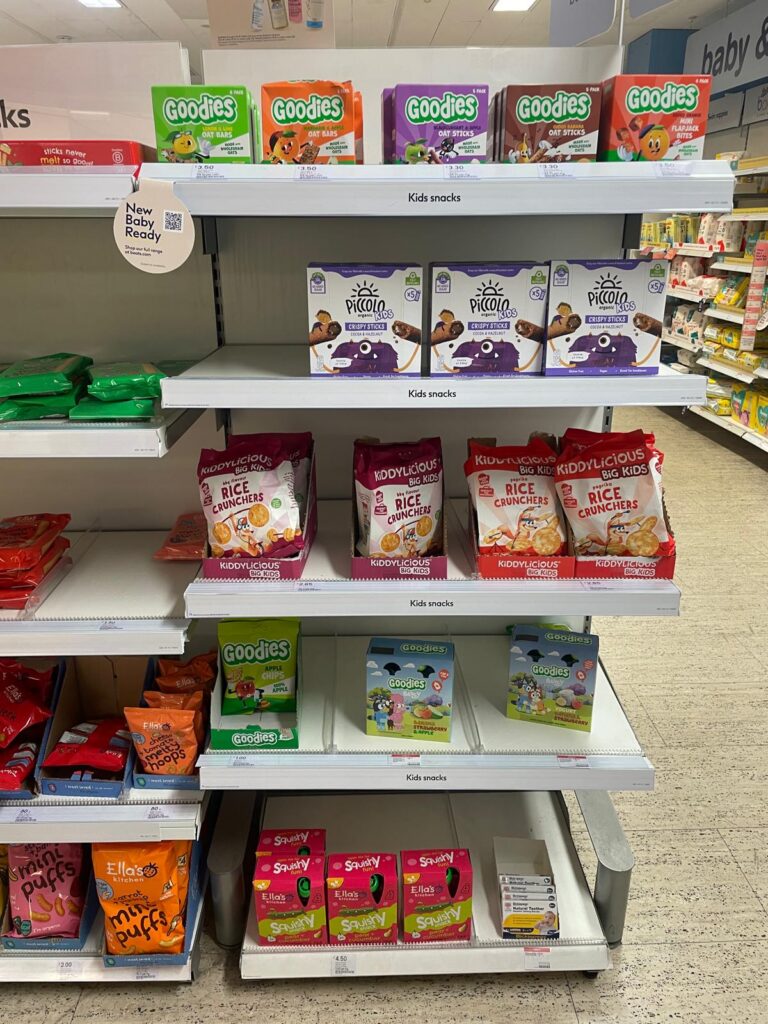
We are also seeing new product launches that fall short from the outset. Piccolo’s recent pouch range, for example, carries claims including “nutritionist approved”, “fussy eater approved” and “nutritional powerhouse” – precisely the kind of promotional messaging that the voluntary guidelines seek to restrict. The yoghurt pouches in the range also lack clear feeding instructions cautioning against direct sucking from the spout, which can cause prolonged tooth contact with sugars and delayed development of chewing and oral motor skills.
“The guidelines were designed to improve the wider commercial baby food environment – what products are available, and how they are formulated, labelled and marketed to parents. Although there have been some encouraging steps, the market is not yet moving at the pace needed to achieve compliance by February. These examples really underline that compliance cannot be reduced to whether a single product meets a threshold; it requires meaningful change across the whole category.” – Katharine Jenner, Executive Director at the Obesity Health Alliance
New analyses in recent months add to the growing body of evidence showing that progress towards improving the commercial baby food retail offer remains limited.
In May, Food Active and the Health Equalities Group assessed 91 baby snacks and finger foods against the WHO’s Nutrient and Promotion Profile Model (which is more rigorous than the UK voluntary guidelines). 81% failed on added sugar and 97% failed on promotional claims. Yet almost 80% would have passed under the UK’s existing model – highlighting that less stringent standards can significantly understate the scale of the problem.
As reported in The Times in late August, Which?’s latest analysis tells a similar story. At the halfway point of the implementation period, 18% of products still failed the sugar guidelines – the same proportion as before the guidelines were introduced. Only three products had been reformulated into compliance. However, the variation observed between brands also shows that greater compliance is possible; just 7% of HiPP products failed the sugar guidelines, compared with 52% of Kiddylicious products.
Other research points to problems beyond composition. An analysis of 224 products from nine leading brands, funded by Alba Health, found that 58% breached at least one element of the guidelines, including labelling and marketing. Meanwhile, further research published just last week in Archives of Disease in Childhood, with CBFR partners First Steps Nutrition Trust as contributing authors, found significant concerns about the texture and nutrition composition of baby food pouches, with only 8% meeting the researchers’ criteria for suitable complementary food.
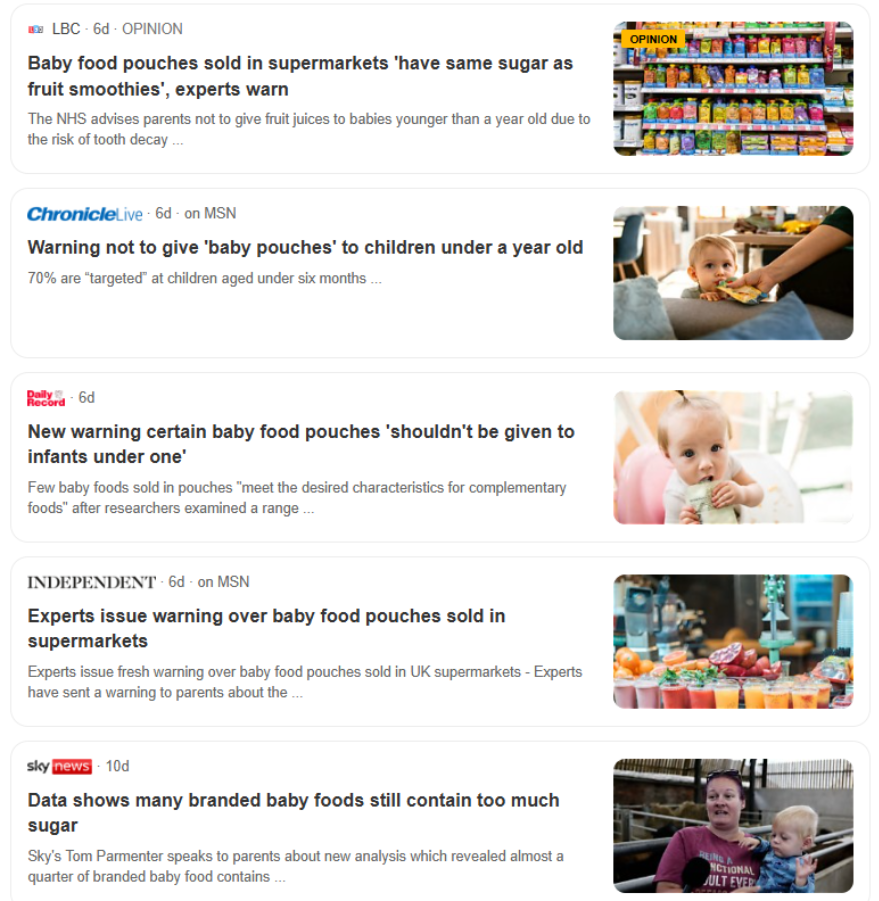
These updates build upon the findings of landmark 2025 research Commercial Baby Foods in Crisis and the BBC Panorama investigation The Truth About Baby Pouches, which helped bring industry practices into public view and contributed to the publication of the voluntary guidelines.
Taken together, they point in the same direction – that voluntary measures are not yet shifting the market at the pace or scale required.
“Whilst nutritional composition is critical, it is only part of the picture. How products are marketed and labelled matters because misleading health claims, age recommendations and promotional messages shape parents’ perceptions of what babies and young children should eat – and ultimately negatively influences their diets.” – Dr Vicky Sibson, Director at First Steps Nutrition Trust
The CBFR’s forthcoming evaluation will build on this growing evidence base, but will go further in four important ways:
Developing a methodology that is transparent, reproducible and robust enough to withstand scrutiny has been challenging but is a crucial part of the process. The marketing element is particularly important – and has not been examined in depth by other analyses published to date. Assessing nutritional composition is largely a quantitative exercise; whereas understanding marketing requires careful interpretation of language, imagery and implied claims against guidelines that can, at times, leave considerable room for interpretation.
Six months from now, the industry will be expected to demonstrate that voluntary measures can deliver meaningful change across the market. The evidence so far suggests that the pace of progress is not sufficient – particularly when it comes to marketing and labelling – and that significantly more action will be needed before February 2027.
Government has committed to “consider additional or alternative measures if businesses fail to implement these guidelines.” As the deadline approaches, the question is no longer simply whether some progress has been made – it is whether voluntary action can deliver the scale and consistency of change needed.
If it cannot, Government must be prepared to act.
Children's health and food
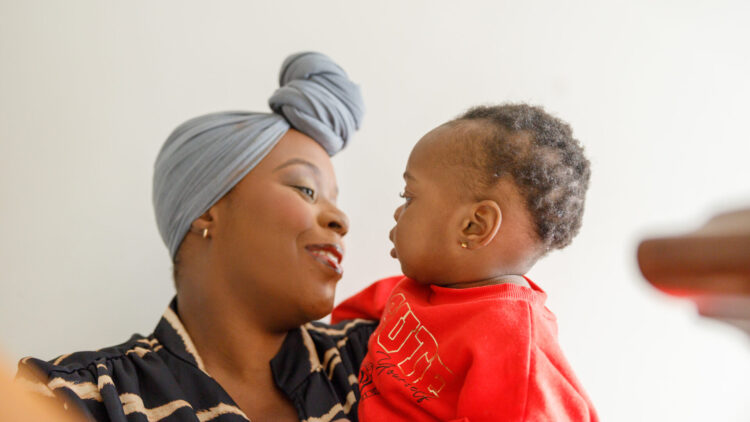
This report captures the perspectives of those working in and around breastfeeding and creates a policy and practice landscape of breastfeeding at local and national levels.
Children's health and food
Head of Policy and Influencing Mark Heffernan reflects on progress made towards creating a healthier food system, and what needs to happen next to ensure transformative change.
Children's health and food
With Bremner Consulting