People are walking outside of Brixton Underground Station

Innovation

Shifting the Power in Research

We partnered with Wellcome to explore how community-centred research can reduce health inequities.

Introduction

People that experience the sharpest health inequities can benefit the most from research. However, they don’t often have a say in what research is conducted, how it is carried out or what projects receive funding.

Although people can learn from research and feel inspired by it, they rarely have real opportunities to take part in ways that strengthen and support their neighbourhoods.

When funding decisions do not include the voices and lived experiences of those most affected, research is less likely to lead to lasting improvements in health. Currently, people with more time, money and experience are more likely to access funding. However, their views may not match the needs and priorities of those facing poor health – and they may have conscious or unconscious biases.

As funders, we have resources such as knowledge, expertise and networks. By working in partnership, we can create opportunities for people experiencing health inequalities to help shape and play an active role in the systems and services that impact their health.

That’s why, in 2021, we partnered with Wellcome in a £3m portfolio – Shifting the Power in Research – to explore how community-centred research and funding models can help address health inequalities in the south London boroughs of Lambeth and Southwark and beyond.

We had three aims:

  1. Challenge existing practice and culture: Through focussing on the experiences and perspectives of communities in Lambeth and Southwark.
  2. Explore new models and build evidence
    • Testing new approaches to the way research is funded, designed and shared
    • Centring the experiences and perspectives of the people and communities who would benefit from the research
    • Sharing the evidence of what works with other funders.
  3. Give power to communities: Enabling people experiencing health inequities to exercise agency and control over health research that has a direct impact on their lives.

“If you’re part of a community that you’re researching, it means you have access to certain networks, conversations, debates and ideas that dwell in that community, which outside research institutions very rarely access.”

Dr Shaun Danquah, Founder and Director, Cen-Alliance

Shifting the power in research through a new interdisciplinary health and social equities hub at King’s College London

In January 2021 we worked with Wellcome and King’s College London to bring together researchers, community leaders, policymakers and health professionals in the Health and Social Equity Collective (the Collective).

Organisations supported through the programme included:

At the heart of the partnership was an ambition to transform how health equity research was conducted. By co-creating new ways for a range of stakeholders to collaborate, it aimed to make research more inclusive, responsive and effective.

Growing community expertise with Centric Community Research

Centric Community Research (now Cen-Alliance) was founded in 2021, working through a broad network of community researchers embedded within their own neighbourhoods. Grounded in shared lived experience, Centric’s researchers accessed and interpreted insights that are often out of reach for traditional forms of research.

With early seed funding from the Shifting the Power in Research partnership, Centric worked to reshape how community insight informs health research and interventions – partnering with funders, healthcare providers, local authorities, and research institutions.

Centric had a number of key approaches at the heart of how they worked:

Exploring community research eco-systems with Rooted

Our exploration into community research best practice and inclusive forms of governance led us to work with Rooted, social designers who centre the experiences, needs and futures of UK Black communities in their work. ​Together, we learnt more about the community research ecosystem, discovering opportunities to invest in local forms of knowledge-generation and new types of leadership.

We learnt that existing community assets must be acknowledged, and that knowledge is already being created within communities – but not in ways that funders necessarily expect. There is therefore a need to respect and amplify spaces where this knowledge creation is already happening.​ Read the report: Exploring Black-led Community Knowledge (pdf).

This work examined the nuances of language across different Black communities and how this shapes the way research is designed and delivered. It explored how language can empower those who often feel “locked out” of mainstream discourse and questioned the hierarchy of knowledge in research: who sets the agenda, whose questions are asked, and whose voices are heard.

Rooted challenged us to “nourish” the research ecosystem by investing in what already exists in Lambeth and Southwark. The learning from this work has since been embedded into our approach, seeding further community-led research and capacity-building initiatives across both boroughs.

Backing participatory grant-making through The Giving Lab

Most funding models continue systemic inequalities because they do not involve the people whose health is affected. Instead, they rely on experts to decide research priorities and funding choices. However, these experts’ views often differ from the real needs and priorities of people experiencing health inequalities.

This gap can lead communities to mistrust research and funding organisations. It can also reduce the positive impact that funding and community resources could have on health. As funders, we have a responsibility to address this.

How money flows through a system shapes relationships, ways of working and power. If we want research culture to change, funding practices must change too.

In 2018 we commissioned TSIP to research participatory, inclusive and democratic funding models. They spoke to funders and community members to understand what barriers and opportunities exist to create a new type of fund that centres lived experience and local knowledge, giving agency to those who’ve traditionally been the furthest away from funding decision-making.

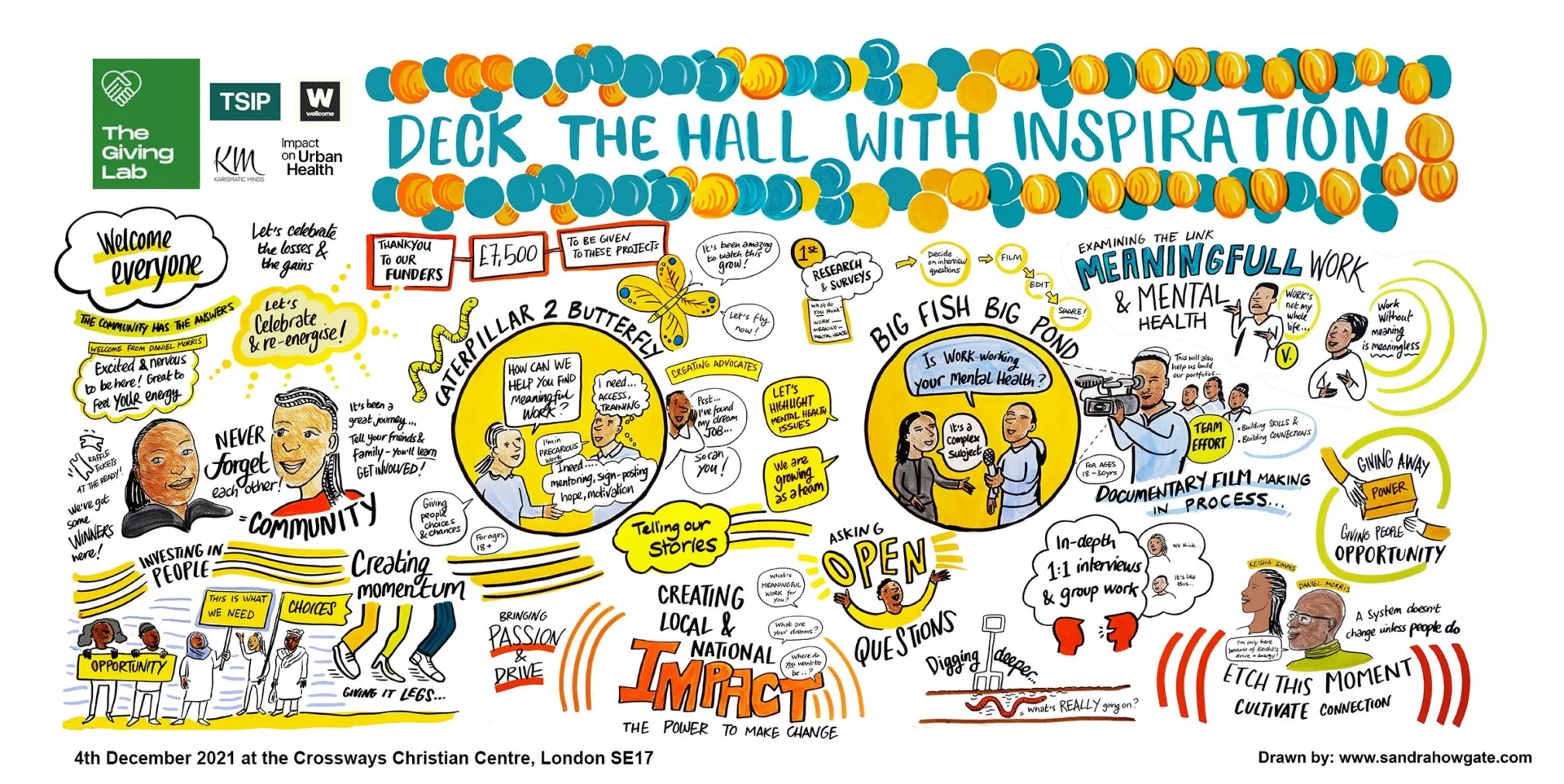
The Giving Lab – co-developed with 155 Southwark residents – was launched in 2021 to provide opportunities for people to make lasting change in their local area. It focused on three key areas of their lives – where they live, where they work and how they manage their money. This is because evidence shows that people’s work, housing and money can have a big influence on people’s health.

Through research, learning and collaboration, The Giving Lab provided a space for community members to work together – using their first-hand experiences and local knowledge – to think of new ways to create healthier lives. Funding decisions were made by people from the community to support projects for their community – with ongoing support to develop budgets, manage their projects and in turn break the traditional power dynamics between funders and recipients.

In total, 69 grantees were funded to run 57 projects, with nearly £500,000 awarded to community members to back ideas around protecting people’s health, supporting them at work, tackling issues with their housing or preventing money driving poor health.

Shifting power to communities in South London through the THINC fund

In 2025, we partnered with Clearview Research to launch the Tackling Health Inequalities Through Neighbourhood Collaboration (THINC) Fund.

Between June 2023 and April 2024, we partnered with Clearview Research to recruit Lambeth and Southwark residents to design a governing structure for the fund, known as the Community Boards. In early 2025, more than 4,500 letters were sent to households across Brixton and Peckham, inviting residents to apply to join the Community Boards. Everyone who responded was entered into a random lottery, ensuring the Board is community-led and broadly representative of the neighbourhoods it serves.

Made up of local residents, the Community Boards shaped the fund to reflect community priorities and stay grounded in local needs. Members took part in training on equity, diversity and inclusion, community research, and team building. This included working with the Amos Bursary to explore their individual strengths and how to collaborate effectively.

With £400,000 available, the funding call focused on projects that support people’s mental health and improves access to healthier food choices.

The fund was designed to reach groups that do not typically apply for or receive funding, removing barriers and widening access.

In December 2025, 29 projects were selected for funding through a public vote, which included large, medium and small projects across Brixton and Peckham. They included Wellbeing at the Windmill in Brixton, the Peckham Soup Kitchen, Develop and Empower Women and Girls in Sports and Nunhead Community Art for Health.

Shifting the power podcast

In 2025 we recorded Shifting the Power Playback, a podcast series where we spoke with Impact on Urban Health staff and people from community organisations in Lambeth and Southwark to explore what it means to share power. It was motivated by our ambition to close the feedback loop with communities and explore innovative ways to engage with them.

Listen to Shifting the Power Playback on Spotify:

Four themes emerged from the series, highlighting the practical changes needed to move from traditional funding models to more participatory, community-centred approaches:

Shifting the power is an ongoing process

“People talk about shifting, but they don’t recognise how inequitable the power structure is first… Once you recognise ‘we have too much power’ you can ask what power you shouldn’t have, rather than how to do good by giving power over.”

Busayo Twins – Clearview Research

Although our partnership with Wellcome has ended, its legacy continues to shape our work. It has helped us grow as a more participatory funder and embed these practices across our programmes.

We are also moving beyond simply “shifting power.” Instead, we are being deliberate about how we build, share and use power, depending on the role we play in each partnership. To support this, we worked with brap to develop a power framework (pdf) to help us apply our influence consistently and effectively.

Here are some current examples:

Looking ahead

Throughout this journey, we’re reminding ourselves that communities are complex and not homogenous. As we engage more with communities in Lambeth and Southwark, we commit to working with a wide variety of community stakeholders who are diverse in their representation of those living locally.

We want to see funders, policymakers, community groups and service providers working together in a way that is genuinely participatory. This means investing in community-led research, fully understanding the barriers to inclusion and acting on the best practice that is generated by other organisations.

Contact us

Get in touch with us if you’d like to learn more about our journey to Shifting the Power.

james.shearman@urbanhealth.org.uk
>